What is backtesting?
Portfolio backtesting is the process of reviewing how an investment strategy would have performed in the past by using historical data. Its purpose is to help investors understand how different strategies behave over time.
What value can portfolio backtesting provide?
A backtest does not prove the effectiveness of a strategy nor does it guarantee future performance.
However, that doesn't mean backtesting is useless. When used correctly, it provides valuable insights into how a strategy behaves, what risks it carries, and whether it is worth considering in the first place.
1. Identifying underperforming strategies
The biggest value of backtesting is not finding winning strategies, it's filtering out losing ones.
If a portfolio performs poorly across long periods of historical data, under different market conditions, or compared to simple benchmarks, that's a strong signal that something is wrong.
That doesn't mean your strategy will never work, but it does mean there's no strong evidence it deserves your capital.
If a bridge collapses multiple times under testing, you know it's unsafe.
But if it doesn't collapse during testing, that doesn't prove it will never fail in the future.
2. Understanding how portfolios behave in different conditions
One of the most valuable things backtesting can show is how different portfolios behave during market stress.
This helps investors understand the "stomach-churning" volatility they might experience and whether they have what it takes to stick with the portfolio during deep drawdowns.
By examining how different portfolios behaved during the 2008 financial crisis, investors can better understand how those portfolios react under severe market stress.
Let's compare:
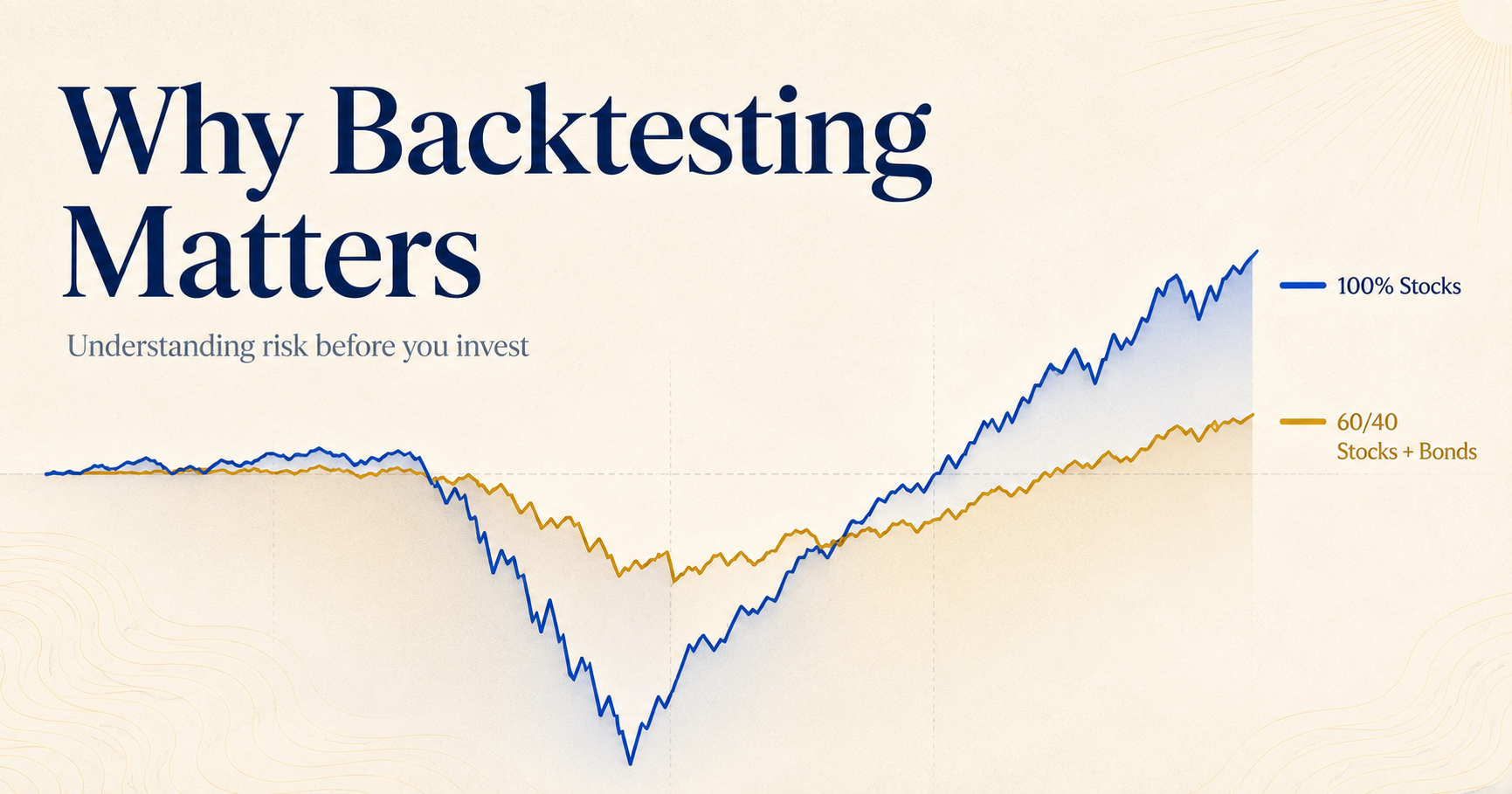
The portfolio with only stocks dropped almost 50% during the 2008 financial crisis, while the portfolio with both stocks and bonds dropped around 25%.